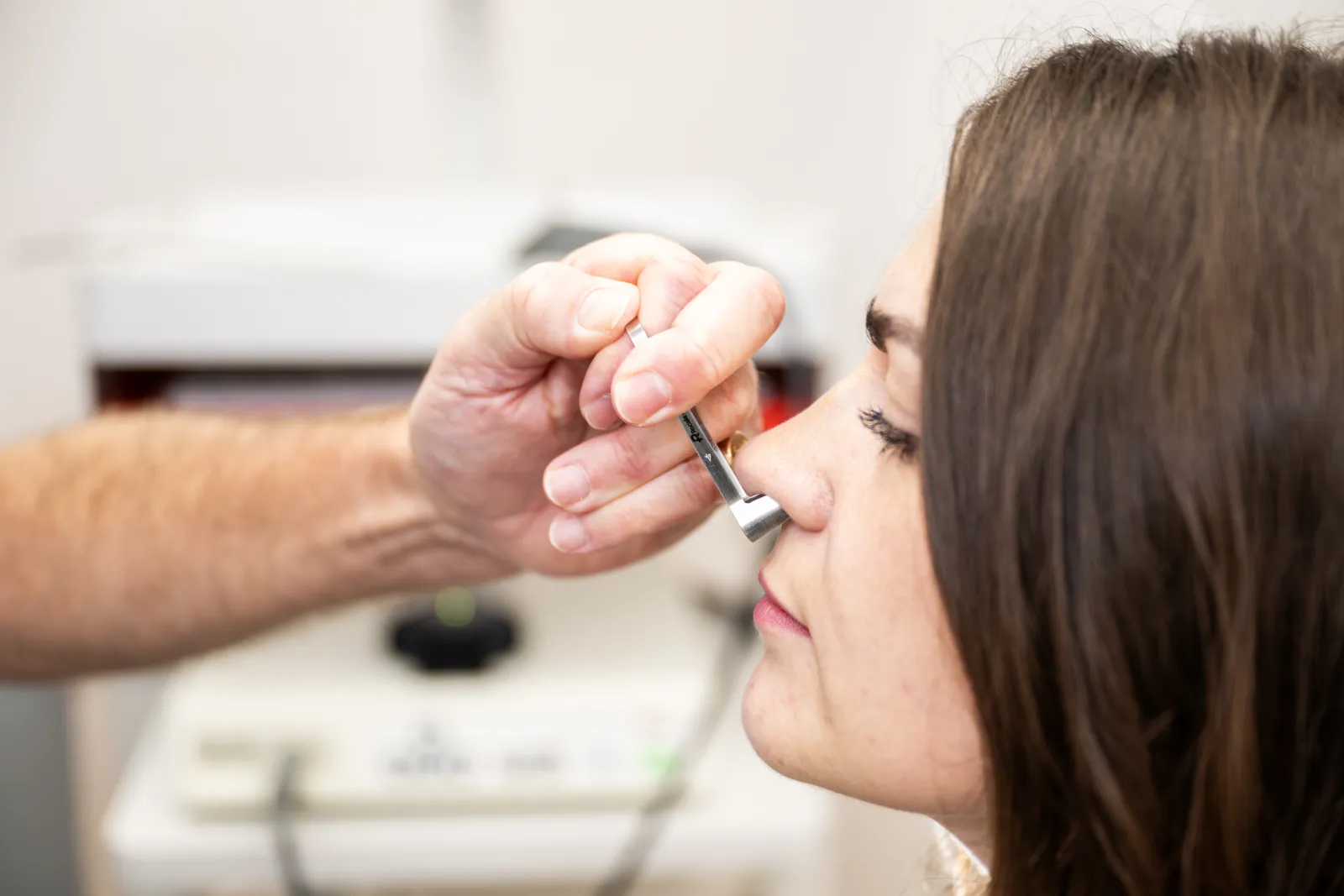
Stopping a nosebleed
Most nosebleeds are short-lived, and usually stop on their own or by pinching the nose. This is best done by leaning forward over a bowl or sink and pinching the front (flexible) part of the nose on both sides between thumb and forefinger, closing the nostrils so that you have to breathe through the mouth. Do this for 10 to 15 minutes; an ice pack (or a packet of frozen peas) held over the nose and face often helps. Sucking an ice cube at the back of the mouth may also help to close the bleeding blood vessel.
Once the bleeding stops, don’t blow the nose for 24 to 48 hours, as you risk dislodging the clot that has plugged the bleeding blood vessel. Avoid hot and/or spicy food and drinks, and hot showers or baths, for a similar period.
When to seek urgent help
If the bleeding is heavy and prolonged (longer than 20 minutes) this is not normal, and the best thing to do is to go to your local Accident & Emergency department — ideally The William Harvey Hospital in Ashford, where junior ENT surgical colleagues are on site.
How we can help
If the nosebleeds are intermittent but controllable, your nose is best examined by us as soon as possible in outpatients. We will be able to look into your nose with an endoscope (a very fine fibre-optic camera) at the time of your appointment, and can often see where the bleeding is coming from straight away. If this is the case, we can usually painlessly cauterise the area with a silver nitrate matchstick, with instant cessation of the nosebleeds once and for all.
If this is not possible, we can offer surgical treatment for the problem without delay. This may involve a septoplasty to straighten your nasal partition, with or without a procedure done endoscopically up the nose to tie off the offending blood vessel (the sphenopalatine artery).
For further information on nosebleeds, please see the NHS guide to nosebleeds.